The Personal Consumption Expenditures price index, published monthly by the Bureau of Economic Analysis as part of the personal income and outlays report, measures inflation across everything households consume — including what employers and government programs pay on their behalf, like employer-covered health insurance and Medicare. The Federal Reserve's 2 percent inflation target is formally defined on this index, specifically the core version excluding food and energy, because PCE's breadth and evolving weights track the economy consumers actually experience. Over the long run, PCE inflation runs a few tenths below CPI: since 2000, the gap has averaged roughly 0.3 to 0.5 percentage points a year.
The Daily News 24 publishes information, not investment or policy advice. This explainer covers how the Fed's target measure works.
How does PCE differ from CPI?
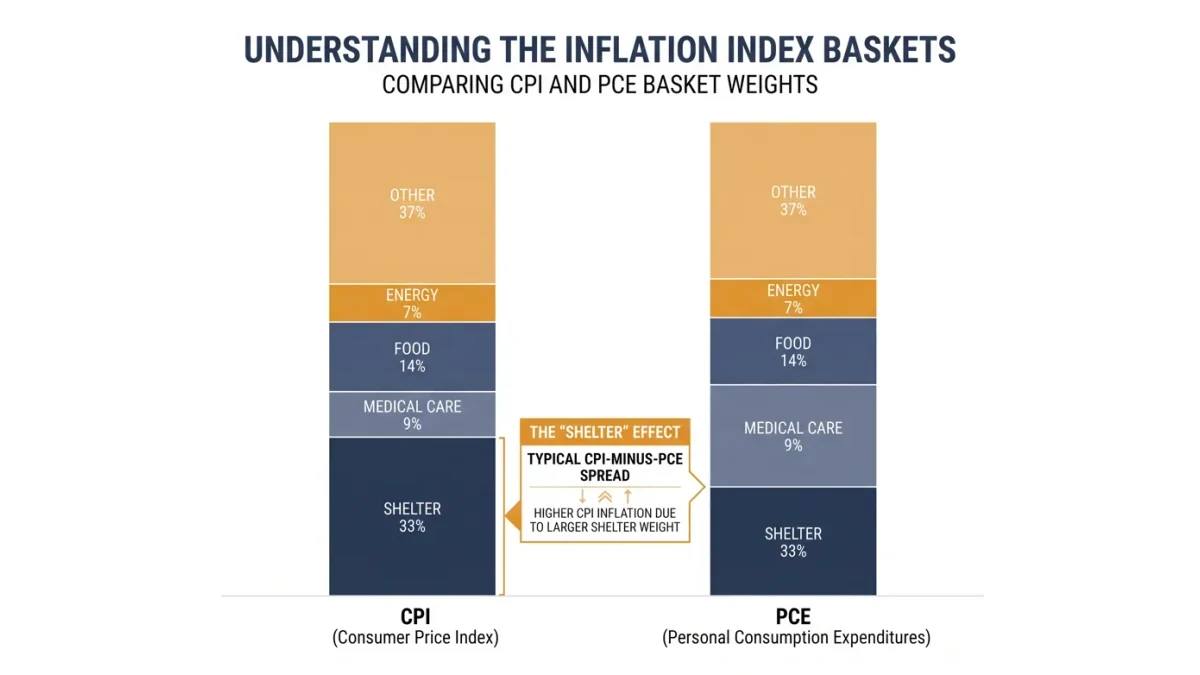
Three differences do most of the work. Coverage: CPI measures only out-of-pocket household spending; PCE adds employer-paid health coverage and medical programs, where prices behave differently. Weights: CPI is a fixed-basket Laspeyres-type index updated annually; PCE uses Fisher chain-weighting that updates continuously as spending shifts — during the 2021–2022 used-car and food spikes, consumers substituted away, and PCE's flexible weights recorded less inflation than CPI's. Scope: PCE includes nonprofit spending on households and, in some categories, imputed items. The same gas-price shock therefore lands harder in CPI, and rent — a third of CPI — carries roughly half that weight in PCE.
Why does the Fed prefer it?
History and breadth. In 2000 the FOMC switched its forecast framework from CPI to PCE, citing the broader coverage and the substitution-resistance of chain-weighting; in 2012 it formalized the 2 percent target on core PCE. A central bank setting policy for the whole economy wants the widest consumption measure, and one that does not mechanically overstate inflation as consumers rearrange their spending. The practical consequence for readers: when the Fed says inflation is still above target, it is speaking PCE — which is typically the softer of the two readings, meaning CPI at the same moment reads higher still.
What is in the monthly release?
The personal income and outlays report, released near the end of each month, carries headline PCE inflation, core PCE, the monthly change, and the spending and income data around it. Because PCE is built partly from retail and other business data that arrive with a lag, the first monthly figure is revised in each of the next two months — more visibly than CPI, whose revisions are minimal. Analysts therefore treat a single surprising PCE month with suspicion until the second estimate confirms it.
How did PCE behave in the 2021–2025 cycle?
Core PCE peaked at 5.6 percent year over year in early 2022, then declined unevenly — with stalls in early 2024 when shelter and services inflation held — before approaching the high-2s by late 2025. The gap versus CPI compressed in places and widened in others, driven largely by the two indexes' different rent measures: CPI's owners'-equivalent-rent weight kept it stickier through the disinflation, while PCE's rotation toward goods as goods prices deflated did the opposite. Watching both shows where the disinflation was real versus where it was weighting arithmetic.
What should readers track?
The core PCE year-over-year line against the 2 percent target, the monthly annualized pace for momentum, and the next two months' revisions to any surprise. The BEA publishes full tables; the Fed's dot plot and statements quote this index, and knowing which inflation number a speaker means is half of reading Fed commentary correctly.