Why does consumer sentiment look terrible while the economy looks solid? According to CNBC, Goldman Sachs has an answer: Americans are not just worried about the economy. They are less happy in general, and that unhappiness is dragging the sentiment numbers down with it. The University of Michigan's consumer sentiment index — a monthly survey asking households how they feel about their finances and the economy — hit record lows this year. In September it fell 13% year over year, including a drop of almost 8% from August alone.
The puzzle is old. Economists have questioned for years why sentiment has stayed depressed since the Covid pandemic even as the economy performed well on paper — gross domestic product growth and stock market performance both offer rosier views than the surveys do. Goldman economist Joseph Briggs told clients this week that the downward pressure may come from somewhere else entirely: broader pessimism in society.
"Low reported economic sentiment likely reflects a more fundamental, downbeat assessment of the state of the world rather than the economy," Briggs wrote to clients, per CNBC. This article unpacks what that claim means, where the data comes from, and what it changes about how to read the monthly sentiment print.
What is consumer sentiment, and why does it matter?
Consumer sentiment is a survey-based measure of how households feel about their own finances and the economy's direction. The University of Michigan runs the best-known version, asking a sample of Americans each month about current conditions and expectations. The number is watched because spending drives most economic activity, and mood is assumed to guide spending.
That assumption is exactly what is under strain. Briggs argued that consumer sentiment may become a less useful predictor of economic dynamics, because it is now tied to non-economic variables. If sentiment no longer tracks the economy, the monthly release tells markets less than it used to. Traders who treat the print as a leading indicator of spending should recalibrate — the signal and the underlying behavior have parted ways.
What does Goldman mean by 'lower happiness'?
Briggs pointed to data from the University of Chicago's General Social Survey, a long-running national survey that asks Americans, among other things, how happy they are. The share of respondents feeling "very happy" fell to 23% in 2024 from 31% in 2016. The percentage reporting "not too happy" rose from 13% to 20% over the same period. Happiness, in other words, never fully recovered from a drop during the pandemic.
The detail that gives the argument its force: overall happiness fell more sharply than the perception of financial satisfaction tracked in the same survey. Americans are somewhat less content with their finances, but considerably less content with their lives. That gap is why Briggs reads the sentiment slump as a mood problem rather than a pocketbook problem — or at least not only a pocketbook problem.
Does inflation still play a role?
Yes, and Briggs said so. He noted that inflationary pressures are likely also hurting confidence. Price levels — not just the rate of inflation — are a standing complaint in household surveys, and a Guardian poll cited in the CNBC report found 95% of Americans think the United States is in the midst of an affordability crisis, with many reporting trouble affording necessities like gas and groceries.
So the picture is two-handed, and Briggs's own framing keeps both hands. Inflation damages confidence directly. But "lower happiness" at large can partially explain the continued disconnect between sentiment and measures like GDP growth or stock market performance. Partially is the operative word. The Goldman claim is not that prices do not matter; it is that prices do not explain all of it.
What does trust in institutions have to do with it?
More than sentiment analysts usually assume. Joanne Hsu, the director of Michigan's survey, told CNBC earlier this year that the downtrend in sentiment mirrors readings showing both decreasing happiness and declining trust in public institutions. Briggs made a similar connection and went further: he found that lower trust in institutions caused a "disproportionate amount" of the decline in net happiness in recent years.
Here is the incentive structure, stated plainly. Sentiment indices are valuable to markets because they are supposed to measure the economy. If they increasingly measure something else — general mood, institutional trust, a downbeat assessment of "the state of the world" — then every consumer of the data inherits a measurement error. The cui bono question applies to the index itself: who benefits from reading a mood survey as an economic forecast? Anyone trading on it, until the correlation breaks.
What happens to sentiment if the economy keeps growing?
It may not improve. Briggs said consumer sentiment readings may not get better even if the economy continues chugging along, given the connection to non-economic variables. That is the practical takeaway for anyone tracking these releases: a strong jobs report or a rising stock market no longer guarantees a bounce in the Michigan index, because the index is partly tracking happiness and trust, which move on their own clock.
It also cuts the other way. A sentiment recovery would not necessarily signal an economic improvement either. The indicator has become noisier in both directions. For readers following price pressures alongside mood, the inflation data remains the harder number: our explainer on How the Consumer Price Index Turns 80,000 Prices Into One Number covers how that measure is built. We covered a connected angle in How the Consumer Price Index Turns 80,000 Prices Into One Number.
How should a newcomer read the monthly sentiment print?
With more caution than before. Three points frame the current state of the data:
- The Michigan index hit record lows this year, falling 13% year over year in September and almost 8% from August, so the level is genuinely extreme, not a rounding artifact.
- The General Social Survey shows happiness down sharply since 2016 — "very happy" from 31% to 23%, "not too happy" from 13% to 20% — which supports the mood explanation.
- Goldman's own economist flags inflation as a concurrent drag, so the happiness thesis is a partial explanation, not a replacement for price-level analysis.
The evidence here establishes a correlation, documented by Briggs and echoed by Hsu: happiness and institutional trust have fallen, and sentiment has fallen further than hard economic conditions justify. What remains unknown is causation at the household level — why happiness fell, and whether it can recover while prices stay elevated. Until that is settled, treat sentiment as a mood gauge with an economic label, not the reverse.
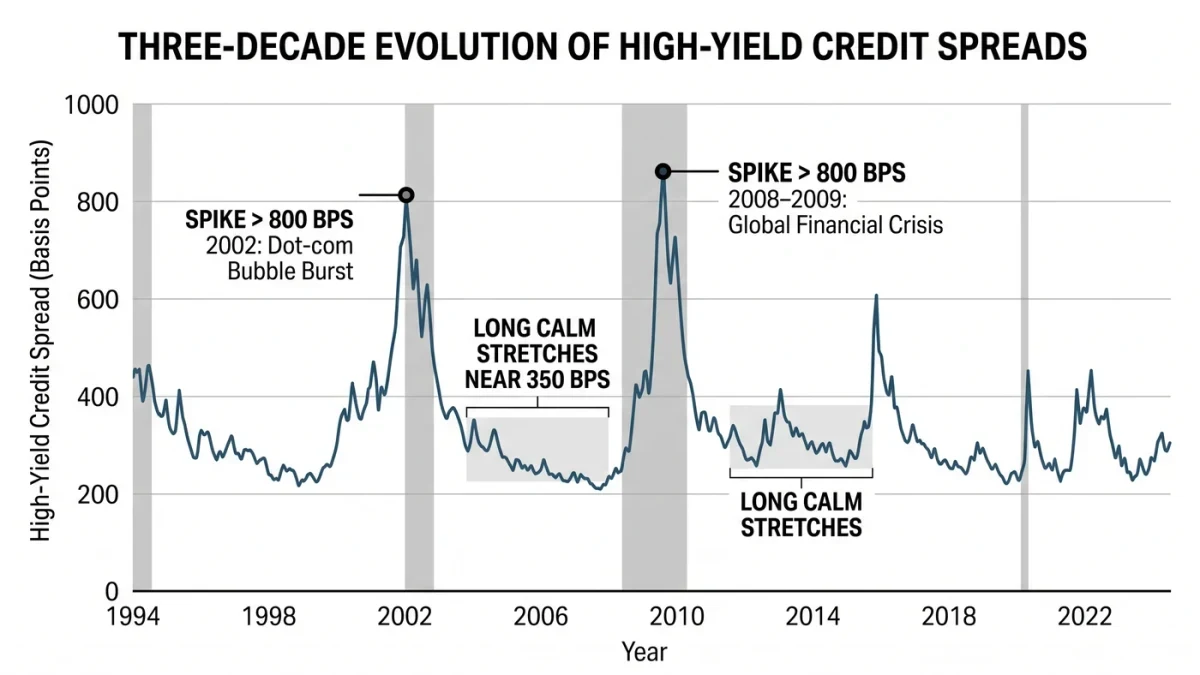
For readers tracking how these readings interact with market pricing, our coverage of Credit Spreads as a Recession Indicator looks at a different signal that still tracks the economy directly. And for the broader context on data releases and price trends, see the rest of our markets and economy coverage. This article is information, not investment advice.