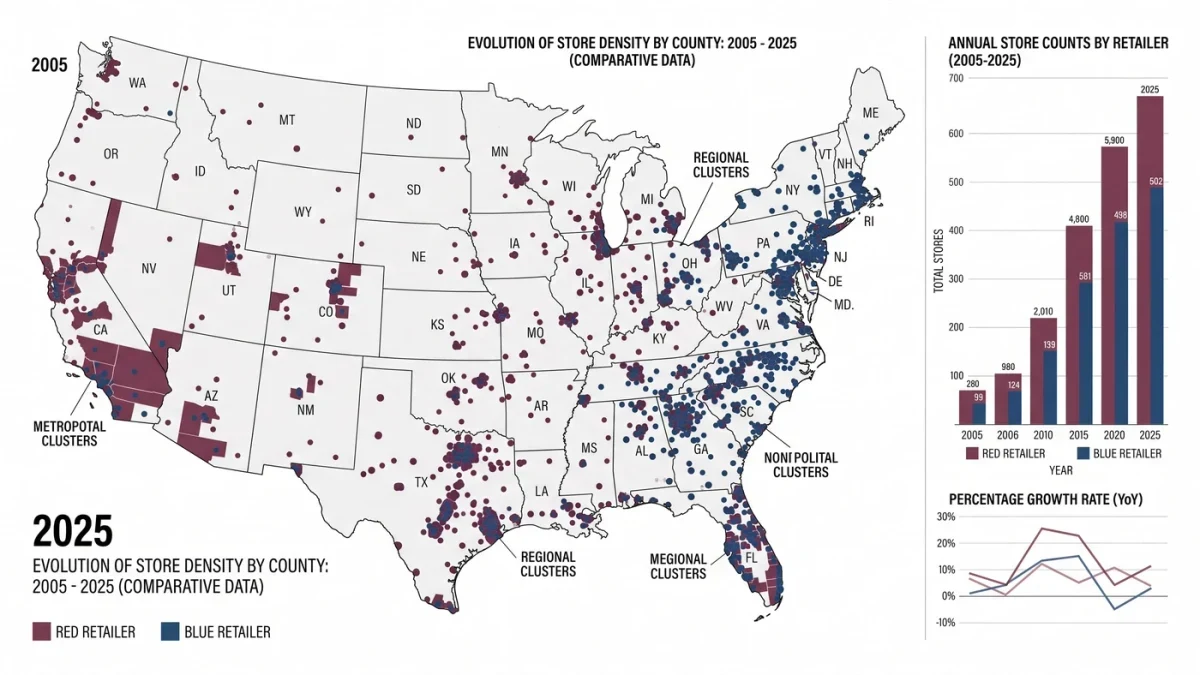
Dollar General operates more than 20,000 U.S. stores and Dollar Tree, with Family Dollar, roughly 16,000 — together about 40,000 locations, more than McDonald's and Walmart's U.S. fleet combined. The model's engine is cost structure: small-format stores of roughly 7,000 to 10,000 square feet, sited in low-rent rural and exurban locations national chains ignore, staffed lean, carrying a limited assortment of consumables. Revenue per store runs around $1.5 to $2 million at Dollar General with operating margins in the high single digits — among the best in retail — built on the paradox that the dollar-store customer shops weekly and the format earns its margin on turns, not markup.
Figures are company filings.
Why did the model expand so relentlessly?
Two tailwinds, one structural. Demographics: the format's core customer — households earning under $40,000 — is geographically concentrated in places where full-size grocery and mass formats cannot profitably operate, leaving dollar stores the only food-adjacent retail for miles. Economics: a dollar store costs roughly $250,000 to $500,000 to build and pays back its investment in a handful of years at the model's margins, so the internal hurdle rate for new stores stayed clear even as other retail contracted — the sector opened thousands of stores through the 2010s while department chains closed thousands.
What broke in 2024–2025?
The core customer. With pandemic savings depleted and low-income budgets squeezed by cumulative inflation, the trade-down wave that boosted dollar-store traffic in 2022–2023 gave way to a demand problem: shoppers buying only necessities, buying less per trip, and — the visible symptom at Family Dollar — being too broke to absorb a price point reset after Dollar Tree moved its namesake $1 price to $1.25 in 2021 and ran multi-price formats after. Family Dollar's underperformance ended in the 2024 decision to close roughly 1,000 stores and, in 2025, sell the chain. Dollar General's answer ran the other direction: lean into food and consumables, shrink assortment, and re-accelerate rural openings where competition is thinnest.
Where does the margin actually come from?
Consumables — food, cleaning, personal care — drive roughly 80 percent of dollar-store sales at lower margin than discretionary, but at trip frequency that amortizes the store's fixed costs. The margin mix works because costs are ferociously controlled: non-union labor at minimal hours, minimal shrink investment until theft forced it, distribution networks deliberately built to serve clusters. The vulnerability is the same lever inverted: when labor and shrink costs rise faster than the price points the brand promise caps, margins compress from both ends — the 2023–2025 pattern at both chains, alongside the strategic flip-flops (self-checkout in, self-checkout out) that theft and shrink forced.
What is the competitive future?
The formats now compete with each other and with everyone's trade-down: Walmart's price position and delivery reach into the same customer; Aldi's expansion — 800 new stores announced 2024 — attacks the food mission directly at lower prices; and e-commerce remains largely irrelevant to the model's customer, which was the format's moat and its ceiling. The mature-market question the chains themselves now answer with fewer new-store commitments: with 40,000 stores, the addressable map is nearly filled, and growth must come from same-store sales — the metric that needs a customer with money.