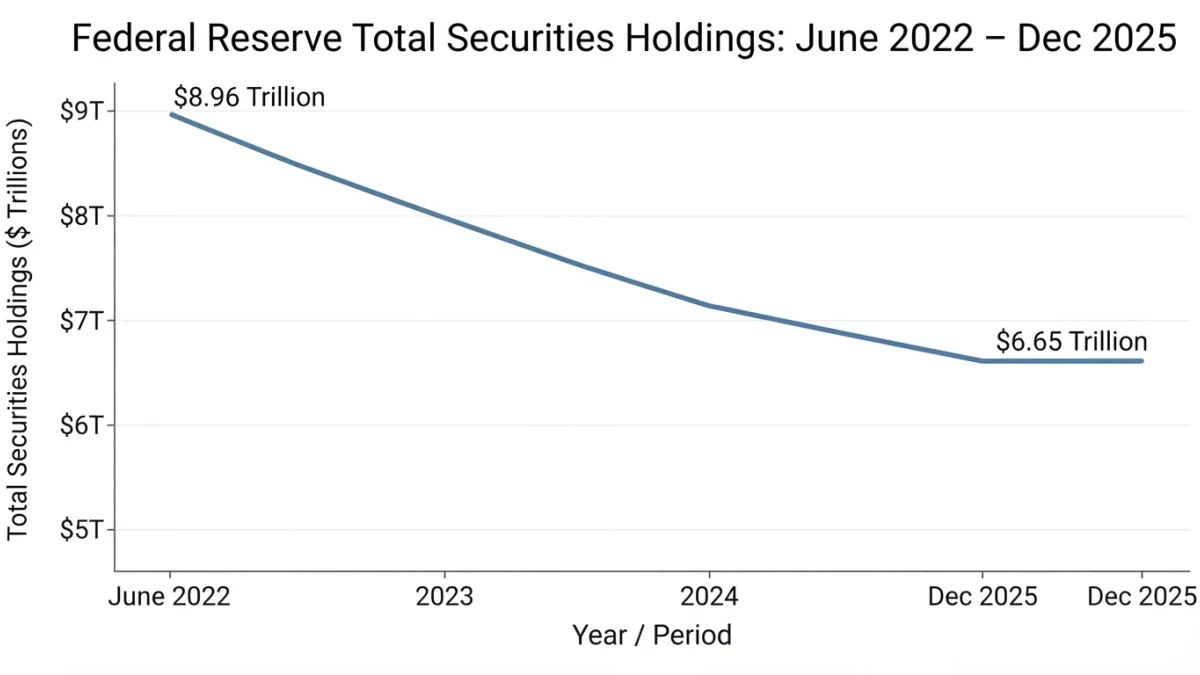
Quantitative tightening is the Federal Reserve letting its holdings of Treasury and mortgage-backed securities shrink as they mature without reinvestment — a passive withdrawal of liquidity that ran at caps of $60 billion in Treasuries and $35 billion in mortgage-backed securities monthly from mid-2022, before the Fed slowed the pace in 2024 and ended MBS reinvestment debates by letting that portfolio run to zero deliberately. The balance sheet peaked near $9 trillion in 2022 and had fallen below $7 trillion by 2025. Unlike rate policy, QT has no dial and no announcement effect on its own — its risk is plumbing, not prices.
The Daily News 24 publishes information, not investment or policy advice. This explainer covers monetary mechanics.
What does the balance sheet actually do?
Assets: the Fed's bond holdings. Liabilities: currency, the Treasury's account, and — the operative one — bank reserves, the deposits banks hold at the Fed. Buying bonds in QE created reserves; letting bonds mature without reinvestment destroys them, as the Treasury pays the Fed and the Fed extinguishes the reserve balances. The stock of reserves is the plumbing through which the fed funds rate transmits, and QT drains it predictably until, at some unknowable point, it drains it too far.
What went wrong in 2019?
The September 2019 repo spike: reserves drained to the point where corporate tax payments and Treasury settlement collided, the overnight repo rate spiked to 10 percent, and the fed funds rate broke above target. The Fed's response — standing repo facilities and permanent repo operations — was a lesson in reserve scarcity: the "ample reserves" floor was learned empirically, not modeled. The 2022–2025 QT cycle was managed against that memory: the Fed slowed Treasury runoff in June 2024 and again in 2025 precisely as reserves approached the levels where 2019 broke, using the Standing Repo Facility and ON RRP drain as buffers.
Why does QT matter for markets?
Through the marginal buyer. When the Fed holds $9 trillion of duration, everyone else holds that much less; as it runs off, the private sector must absorb roughly $80 billion a month of new supply plus rolled-off holdings — demand that has to come from banks, money funds, households, or foreign buyers at some price. The 2023 yield spikes coincided with the heaviest absorption, and the MBS portfolio's runoff is a persistent technical weight on mortgage spreads — one reason mortgage rates stayed high even as the Fed cut.
How does QT interact with the debt ceiling?
Inversely: Treasury draws down its Fed account when the ceiling binds, adding reserves that mask QT's drain, then rebuilds the account after resolution, draining reserves sharply. The 2023 and 2025 ceiling episodes each injected and then removed hundreds of billions in reserve effects, which is why the Fed watches the Treasury General Account alongside reserves in every QT decision — the two move the same pipe from opposite ends.
When does QT end?
When reserves reach "ample" — a range, not a line, that the Fed has defined only operationally as the level above which rate control holds with modest use of administered tools. The endgame sequence from 2019's lesson: slow the pace, watch repo-market signals for scarcity, stop runoff with reserves still comfortably ample, then let the balance sheet drift with currency growth and composition — Treasuries only, per the stated preference — normalize over years. The audience question is always whether the exit is boring. 2022–2025 managed to keep it so.