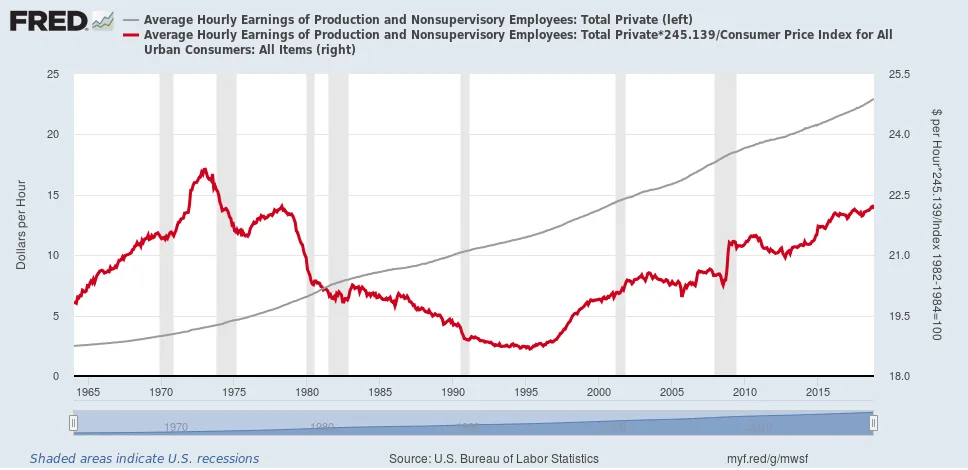
Two workers can earn the same raise and live very different realities. The difference is inflation. Nominal wages are the dollars printed on a payslip. Real wages are what those dollars actually buy in goods and services.
That gap decides whether a raise is a win. When prices climb as fast as pay, a bigger number buys the same cart. When prices climb faster, it buys less. This is why wage headlines deserve a second look before they earn your trust. We covered a connected angle in How the Consumer Price Index Turns 80,000 Prices Into One Number.
What Separates Nominal Wages From Real Wages?
Real wages are wages adjusted for inflation. Nominal wages are unadjusted. Wikipedia's entry on real wages frames the real wage as the amount of goods and services a paycheck can buy, in contrast to the raw dollar figure. Because the real figure accounts for price changes, it gives a clearer picture of what a worker can afford.
The adjustment is the whole point, not a detail. Strip inflation out of a raise and you see its true size. Keep it in and you may be counting a gain that never reaches the store shelf.
Why Can a Bigger Paycheck Buy Less?
Wikipedia's overview of real wages makes the point directly: higher wage growth, if accompanied by higher inflation, can leave workers with lower purchasing power than a stretch of smaller raises and lower inflation. The paycheck grows. The basket shrinks.
The pattern is not hypothetical. Per the same entry, the average paycheck rose 2.7% in 2005 but only 2.1% in 2015, which left some workers feeling they were falling behind. Yet inflation per the same source ran at 3.4% in 2005 against just 0.1% in 2015. The smaller raise was the real raise. Cheaper prices did more work than the bigger number. Readers following this should also see Core CPI Rose 2.5% Year Over Year in July.
Direction matters more than size here. A raise beats inflation, matches it, or loses to it. Only the first case adds buying power. The other two just relabel the same basket or a thinner one.
How Can You Tell a Real Raise From a Paper Raise?
Economists use one clean test. If a worker can now afford every bundle of goods and services they could just barely afford before, and still have money left over, the real wage has risen. That holds no matter how inflation is calculated, because no relative prices enter the comparison.
Many raises sit in a gray zone. Some prices change more than others, so the verdict depends on which mix of goods you track. A raise can feel real for a rent-and-groceries budget and thin for a travel-and-electronics one. Both readings can be true at once.
What Are the Limits of the Real Wage Number?
The real wage is a model, not a meter. Wikipedia's real wages article notes that inflation itself is not well defined, because it can be calculated from many different combinations of goods and services. Relative prices shift too, so no single number fits every household.
Standard wage measures also miss parts of the deal. Per the entry, traditional measures often fail to incorporate extra employment benefits and do not adjust for a changing composition of the workforce. One more lens helps: how much work time it takes to buy an item. By that measure, most items take much less work time to earn now than decades ago, at least in the United States.
Conclusion: Judge Pay by What It Buys
Nominal pay is a headline. Real pay is the story. Before calling a raise a win, check what prices did in the same period, then ask what the paycheck covers this year that it did not cover last year.
Households can act on this without any models. Track your own basket of regular costs against your pay. If the basket keeps growing faster, the raise is thinner than it looks. If it grows slower, you are getting ahead, whatever the headline says.
This article is general information, not investment or financial advice.