Shrink is the retail industry's term for inventory that paid-for accounting says should exist but physically does not — the gap between what a store bought and what it sold. In its 2023 survey, the National Retail Federation put industry shrink at $112 billion, and retailers including Target and Home Depot repeatedly attributed the bulk of it to theft in public statements through 2023–2025. But the same survey's methodology counts external theft, internal employee theft, vendor and warehouse errors, administrative mistakes, and damage together, and no U.S. dataset separates organized retail crime from ordinary shoplifting with survey-grade precision. The number is real; the interpretation is where care is needed.
The Daily News 24 publishes information, not policy or legal advice. Here is how the statistics are built.
How is shrink measured?
A retailer computes shrink the way any inventory-taker does: compare perpetual inventory records to physical counts, value the gap at cost, divide by sales. The NRF's annual security survey aggregates self-reported figures from member companies, which means the headline is a survey of estimates, not an audited statistic. Individual companies report shrink as a percentage of sales in SEC filings and earnings calls — typically 1.4 to 2 percent of sales across the industry in recent years, with drugstores and mass merchants at the high end.
What goes into the theft share?
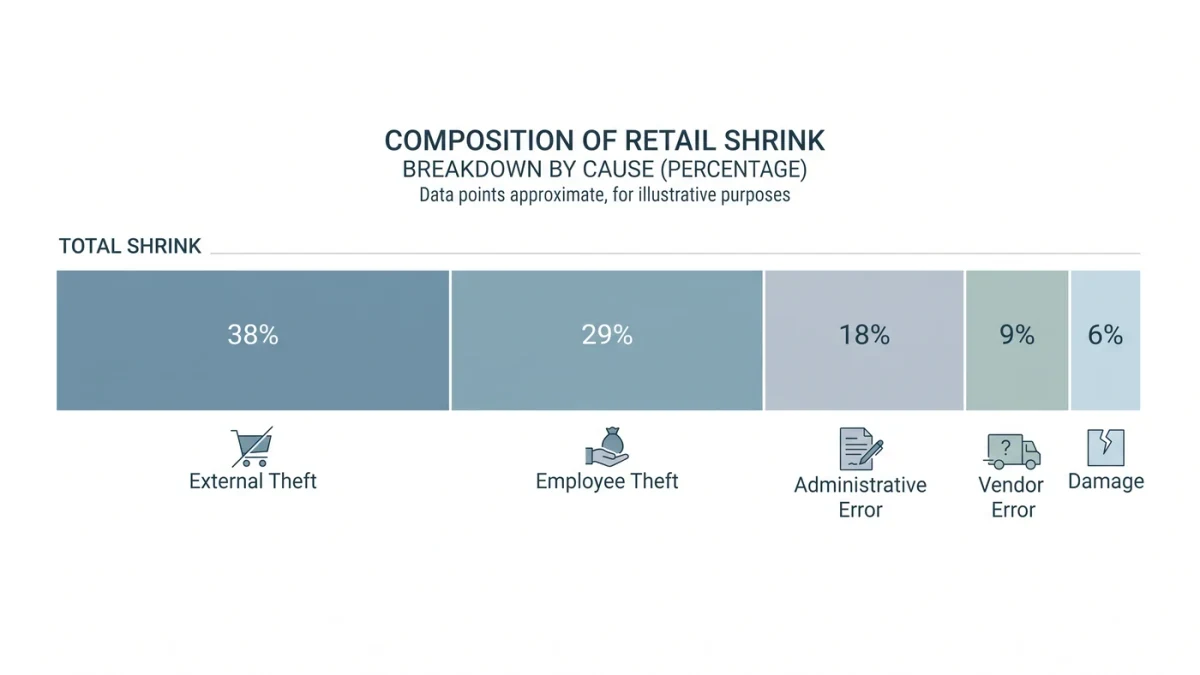
The NRF survey asks retailers to apportion shrink across causes, and external theft plus organized retail crime has typically drawn the largest assigned share — around two-thirds in recent surveys — with employee theft second. Those apportionments are the retailer's own attribution, not convictions or even police reports; a store manager dividing a count gap between a stolen case of detergent and a mis-scanned delivery is estimating. That is why researchers and the Council on Criminal Justice, whose 2023–2024 reviews of available data found shoplifting rising sharply in a handful of cities while flat or falling nationally, caution against extrapolating chain-level anecdotes to a national crime wave — and against reading the NRF total as a theft total.
Why did shrink headlines intensify in 2023–2025?
Several large chains closed stores citing theft and safety, and the industry pressed successfully for the INFORM Consumers Act of 2023, which forces online marketplaces to verify high-volume third-party sellers — the resale channel for stolen goods. At the same time, analysts noted that shrink also rises when retailers cut store staffing, since counting and control degrade together; the two explanations are not mutually exclusive, and both can be true in different chains. Companies that later restated the theft component — including one major retailer's 2023 revision of an organized-crime claim — illustrate how soft the attribution layer is.
What data actually exists on shoplifting?
The hard sources are police-reported incident data gathered under the FBI's NIBRS program and city-level datasets. Those show wide dispersion: large increases in a few West Coast and East Coast cities during 2021–2024, and declines or stability elsewhere. Reported data has its own bias — retailers report some incidents and not others, and reporting practices changed after 2020 — so both the industry survey and the police data are best read as bounds, not points.
How should readers read the next headline?
Three questions: Is the figure shrink or theft specifically? Is the source a self-reported survey or reported incidents? And what period does it cover? A chain's shrink rate is an accounting fact; what share of it is crime is an estimate wearing a fact's clothes.