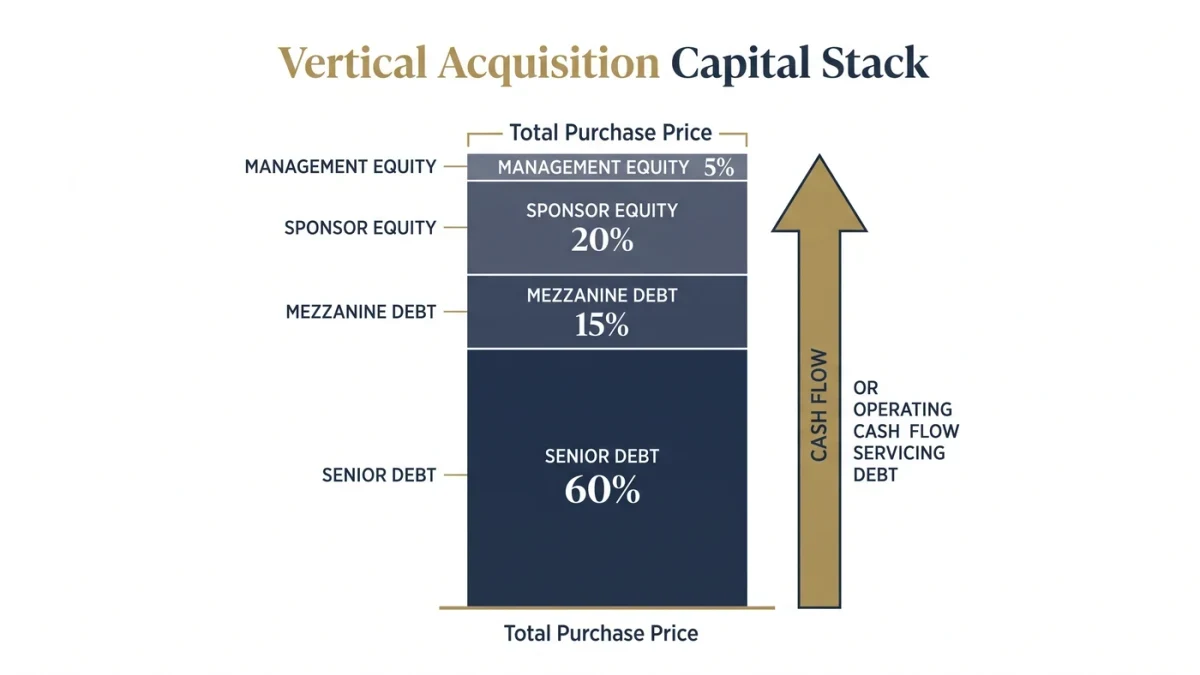
A leveraged buyout acquires a company using substantial borrowed money — commonly 50 to 70 percent of the price — with the debt secured by the target's own assets and serviced by its own cash flow. The private-equity sponsor contributes the equity slice, typically 30 to 50 percent in the modern era versus the 5-to-10 percent equity of the 1980s pioneers, and returns come from three engines: leverage (any value gain accrues to the small equity base), operational improvement, and multiple expansion at exit. The buyout wave's scale is the private-market era's headline: global private-equity dry powder ran above $2 trillion through the mid-2020s, and take-privates of public companies — over $100 billion announced in strong years — recur whenever rates allow.
This explainer covers a financial structure.
Why would being private help?
The claimed advantages: freedom from quarterly guidance, earnings-myopia, and disclosure that broadcasts strategy to competitors; and the ability to restructure hard — close divisions, replace management, reprice the workforce — inside confidentiality. The evidence on operational improvement is contested but real at the median: academic studies find productivity and operating margins improve on average at buyout targets, with dispersion — the median deal improves while the tail loads companies with debt they cannot carry. Employees and creditors fund part of the average: documented wage effects and bankruptcy rates at highly leveraged deals exceed comparable public firms.
What makes an LBO work arithmetically?
Stable cash flow above all: the debt service must be payable in a downside year, which is why the classic targets are companies with durable revenues and modest capital needs — industrials, software with recurring contracts, healthcare services. The rate environment sets the hurdle: at 2021's financing costs, almost anything cash-generative cleared; after 2022's rate reset, leverage fell to four-to-five times earnings from six-plus, equity checks grew, and deal volume halved before recovering with 2024–2025's spread tightening. And the exit must exist: a buyer or IPO market to sell into, which is why fundraising booms precede exit booms and pile up when windows close — the 2022–2024 backlog of unsold portfolio companies became the industry's defining congestion.
What do the different stakeholders get?
Public shareholders receive a takeover premium — historically 20 to 40 percent over the pre-announcement price — and exit entirely. Management usually rolls equity into the new structure, aligning it with the sponsor. Lenders receive contractual yield with the company's assets as security. Employees retain jobs under new, harder budget constraints. And the sponsor collects management fees during holding plus carried interest — typically 20 percent of profits above an 8 percent hurdle — at exit. The structure's criticism and defense are the same fact: every party's incentive points at the debt being serviceable, and when it is not, the priority stack decides.
What happens when an LBO fails?
The over-leveraged company restructures or files: the 2000s' biggest buyouts — the energy-utility and radio-station megadeals among them — spent the decade after 2008 in debt workouts, with equity sponsors wiped out and creditors taking ownership. The modern regulatory note: the FDIC and Fed scrutinized private-credit-funded bank-adjacent lending through 2024–2025 as direct lending grew past $1.5 trillion, the structure replacing the syndicated-loan market for many mid-size deals.
How should readers read a take-private announcement?
Three lines: the premium versus the sector's recent deal norms; the financing structure in the merger documents — equity percentage and debt multiple tell you the risk being transferred; and the go-shop provision, if any, which tests whether a higher bidder exists. An LBO is a bet that private owners can run the asset better than public markets priced it — leveraged enough that being right pays many times and being wrong ends in a filing.