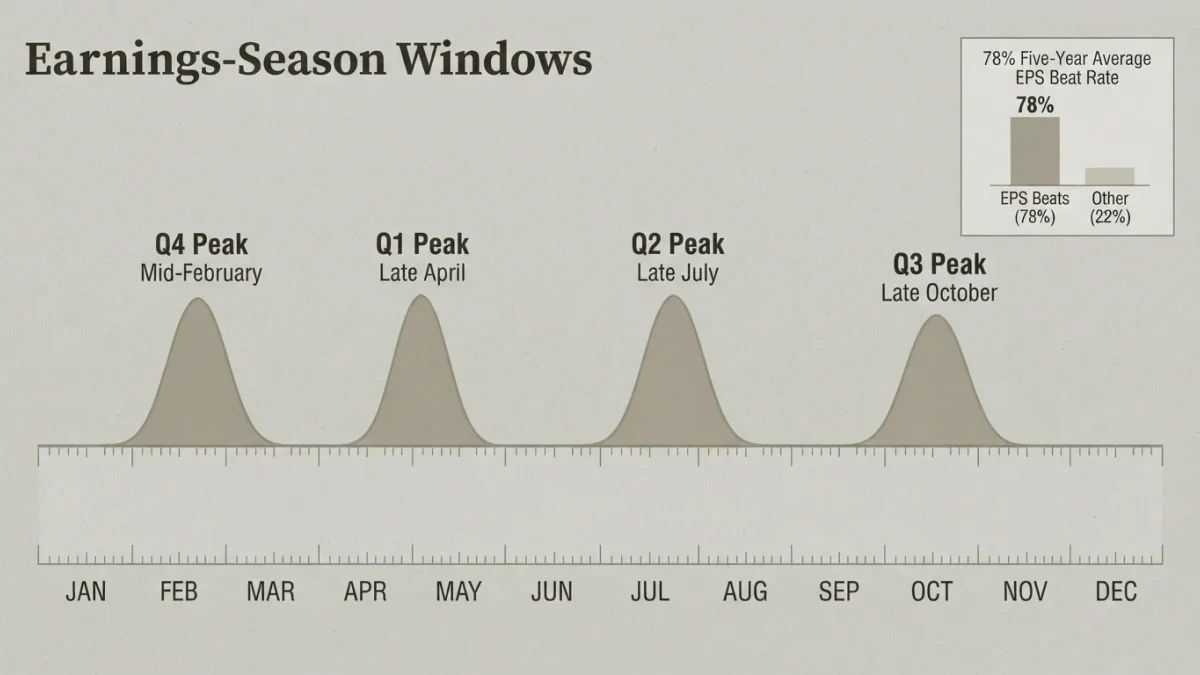
When a company reports quarterly earnings, two numbers matter and only one is about the past. Actual results — revenue and earnings per share against analyst consensus — describe the closed quarter. Guidance, management's stated expectation for the coming period or year, describes the future, and the stock's reaction follows it: companies that beat but guide below consensus routinely fall, and companies that miss while raising the outlook rise. Academic and practitioner studies of the pattern — including long-running analyses of guidance events — find the guidance surprise explains more of the announcement-day move than the earnings surprise itself in guidance-heavy sectors.
This explainer covers market mechanics.
What exactly is guidance?
Public statements of expected future performance: revenue ranges, EPS ranges, margins, capital spending, or key operating metrics like subscriber counts. U.S. companies are not required to give it — Regulation Fair Disclosure governs how material information is shared, not whether forward-looking statements are made — and practice varies: technology and consumer companies guide quarterly or annually, while many financials and utilities give less. The safe-harbor provisions for forward-looking statements exist precisely because guidance is a forecast that can miss.
Why does the market price guidance so hard?
Because a stock's value is the discounted future, and guidance is the only forward information management is willing to stand behind. Analyst models anchor to it; a guide-below resets every estimate downstream. The magnitude asymmetry is well documented: guidance disappointments produce larger single-day declines than equivalent beats produce gains, because a cut confirms a worse base case while a raise was often already traded toward. Positioning compounds it — when a stock is crowded long, a mere in-line guide can trigger the exit.
How has guidance practice changed?
Two shifts define the 2020s. Withdrawals: a wave of companies — several dozen S&P 500 members over 2020–2024 — stopped giving formal guidance, arguing volatility made forecasts worse than silence; research on withdrawal episodes finds short-run information cost with little long-run damage. Guidance gaming: issuing ranges a company expects to exceed, "beating" by a penny with suspicious regularity. Both behaviors are visible in the data: the fraction of S&P 500 companies beating both consensus and their own guides has risen for two decades, which tells you the bar moved, not that corporate America improved.
What is the whisper number?
The informal expectation among traders — often above published consensus after a run of beats — that a stock must clear to rise. It is not data, but it explains outcomes that "beat and fell" headlines miss: the official consensus was cleared; the whisper was not.
How should readers interpret a guidance cut?
Look for the language that distinguishes timing from trajectory: "pushed to next quarter" is a calendar problem; "lowering full-year" is a demand problem. Watch whether the cut comes with margin guidance intact (cost control holding) or collapsing (pricing power gone). And note what the company stops guiding — the metric withdrawn from outlooks is usually the one deteriorating fastest. The reaction tells you the market's revised base case; the text tells you why.