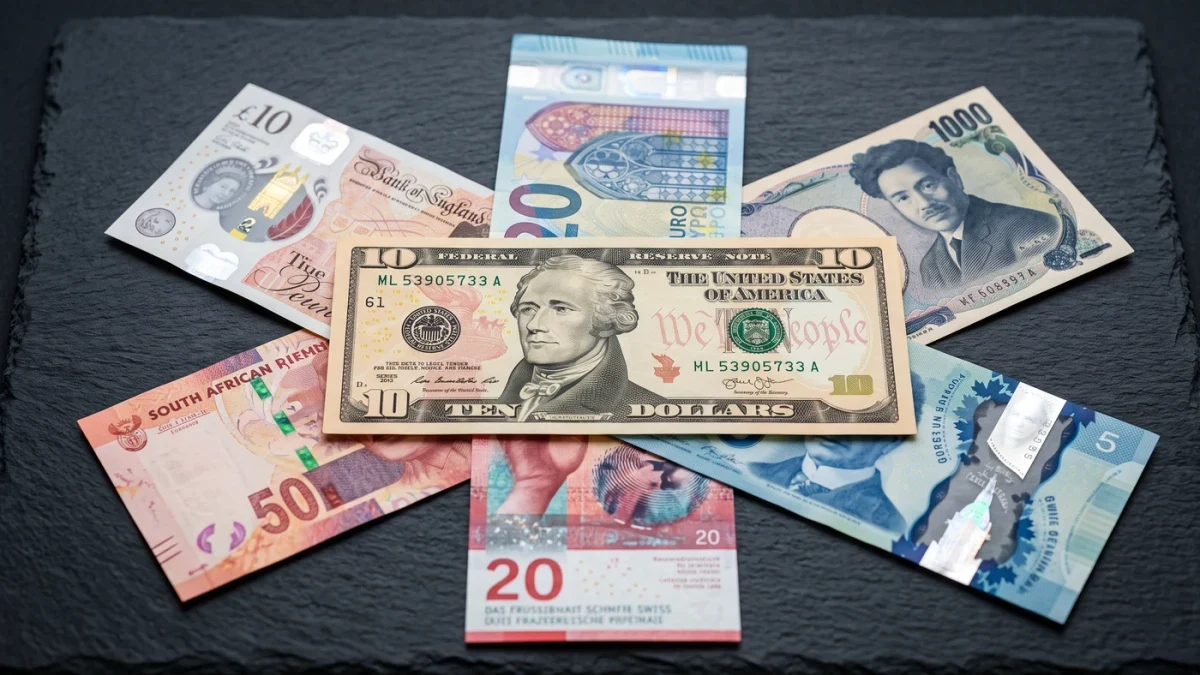
The U.S. Dollar Index — DXY — measures the dollar against six currencies: the euro at 57.6 percent of the basket, the Japanese yen 13.6, the British pound 11.9, the Canadian dollar 9.1, the Swedish krona 4.2, and the Swiss franc 3.6. A reading of 105 means the dollar is 5 percent above its March 1973 base of 100. The index is maintained by ICE and trades as futures and options, and its concentration is both its usefulness and its distortion: more than half the reading is one exchange rate, and the weights reflect 1973 trade patterns that no longer describe American commerce.
This explainer covers index construction.
Why those six currencies?
The index was built in 1973 after the Bretton Woods system collapsed, weighting the currencies of the dollar's then-major trading partners. The euro inherited the combined weights of the deutsche mark, French franc, and other predecessor currencies at its 1999 launch. The anachronisms accumulate from there: Sweden is a minor U.S. trading partner with a 4.2 percent weight, while China, Mexico, Korea, and India — the largest current trading partners — are absent entirely. When the dollar moves against the peso or the yuan, DXY does not record it unless the move propagates through the six.
How should the reading be interpreted?
Levels only versus history — the 2022 high near 114 was the strongest since 2002, and the 2021–2025 swings ran from about 89 to 114, a range of valuation with real trade consequences. Momentum and trend in DXY feed every asset class shorthand: dollar strength pressures commodity prices, emerging-market dollar debt, and multinational earnings; weakness relieves them. But the interpretation must respect the basket: a euro-specific shock — an energy crisis or French political scare — moves DXY as a "dollar" story when the dollar did nothing.
What are the alternatives?
The Federal Reserve's trade-weighted broad dollar index covers 26 currencies weighted by actual goods trade and is published monthly — the measure economists use for trade and competitiveness analysis. The Bloomberg dollar index tracks a basket aligned to current flows with real-time pricing. Currency-specific rates answer questions DXY cannot: dollar-yen for carry trades, dollar-peso for nearshoring, euro-dollar for transatlantic trade. The professional habit is matching the index to the question, and treating DXY as the liquid, traded shorthand rather than the measurement.
What drives the index?
Rate differentials above all: expectations for the Fed relative to the ECB, BOJ, and BOE move the two-year interest gaps that carry traders price, and DXY follows. Growth and risk appetite next — global stress buys dollars as the safe haven, which is why the index rose in March 2020 and during 2022's energy shock. And terms of trade: the U.S. energy position since the shale era softened the classic oil-shock dollar damage. The 2024–2025 pattern — Fed cuts alongside a resilient index — reflected the rest of the world cutting faster.
How is it traded?
ICE lists futures on the index, and inverse and leveraged ETFs exist for retail exposure; futures dominate. The honest caveat for traders: DXY's six-currency construction means a euro event is half your position, and hedging or expressing a dollar view against the currencies that actually matter to a portfolio requires going around the index, not through it.