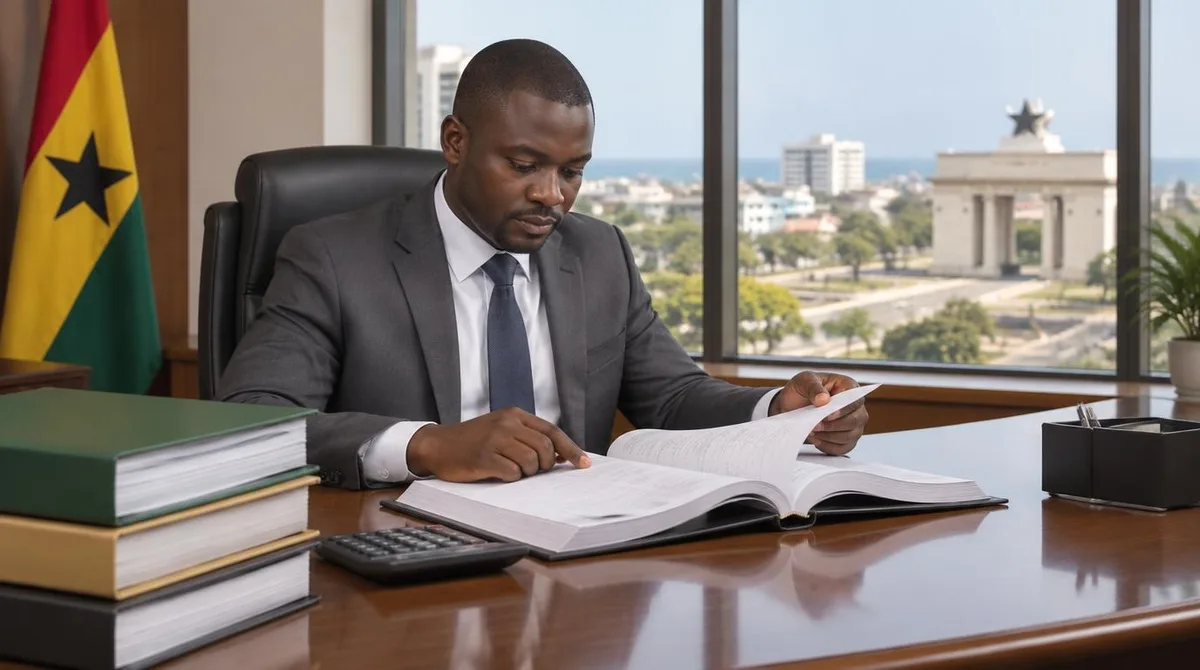
Ghana's government has allocated GH¢100.4 billion for capital expenditure in 2027 — 5.6 per cent of gross domestic product — to fund infrastructure and growth. Finance Minister Cassiel Ato Forson set out the figure when presenting the 2027 Budget Statement and Economic Policy to Parliament on Thursday. Of the total, GH¢88.4 billion is domestically financed and GH¢12 billion comes from external financing, according to Ghana Business News.
The popular assumption with a budget like this is that a government is spending its way to growth. The 2027 numbers ask readers to test that claim against a second set of figures. The same budget targets a fiscal deficit of GH¢65.8 billion, or 3.6 per cent of GDP on a cash basis, and a primary surplus of GH¢9 billion — 0.5 per cent of GDP on a commitment basis. It also pledges no new taxes. Capital spending at 5.6 per cent of GDP, alongside a shrinking primary deficit, means the government is betting that better revenue collection, not borrowing, carries the construction programme.
The revenue side of that bet is explicit. Dr Forson said the budget would focus on improving revenue mobilisation, closing leakages and modernising tax administration, with reviews of the Income Tax Act, the Revenue Administration Act, Stamp Duty administration and the Communications Service Tax framework. Whether those reforms deliver is the question on which the whole capital programme turns, and it will not be answered by the budget speech itself.
What's actually in the GH¢100.4 billion?
The headline number covers more than roads and bridges. The largest single line is GH¢28 billion for the Big Push Programme, which the government describes as an effort to improve infrastructure and connectivity across the country. Within it, GH¢2 billion goes to the Ghana Market Access and Connectivity Project and GH¢400 million starts the Volivo Bridge project.
Beyond the Big Push, the Ministry of Roads and Highways receives GH¢11.3 billion — GH¢7.8 billion for capital expenditure and GH¢3.5 billion for a Road Maintenance Trust Fund. The Ministry of Transport gets GH¢724 million, split between GH¢400 million for additional high-occupancy buses, GH¢174 million for railway development and GH¢69 million for preparatory work toward a national airline. The transport lines are small by comparison, but they show the budget reaching into several modes at once rather than concentrating on one flagship. For related coverage, see How Share Buybacks Work.
How do education and health fit into the capital plan?
The social sectors carry much of the construction load. Education receives GH¢48 billion, including GH¢11.2 billion for the Ghana Education Trust Fund, which funds school infrastructure, per Ghana Business News. The sector allocation also includes GH¢1.37 billion to transform secondary education and eliminate the double-track system — a scheduling arrangement that splits students into two shifts to ease classroom overcrowding — and GH¢537 million for the No Fees Stress Policy covering first-year tertiary students.
Health gets GH¢40.3 billion, of which GH¢6.8 billion starts construction of two specialist hospitals, six regional hospitals, a mother and child centre at Korle-Bu Teaching Hospital and two district hospitals. Completion money is separate: GH¢1 billion for the Eastern and Western Regional Hospitals and another GH¢1 billion for 35 Agenda 111 district hospitals, Ghana Business News reports. The National Health Insurance Scheme receives GH¢10.2 billion and the Ghana Medical Trust Fund, known as MahamaCares, GH¢2.6 billion.
Reading the two sectors together shows a pattern: large recurrent programmes — insurance, school subsidies, trainee allowances — sit beside multi-year building projects. The capital expenditure figure captures the building; the operating costs of staffed hospitals and schools arrive in later budgets.
Why does the financing split matter?
The GH¢88.4 billion domestic share versus GH¢12 billion external is the budget's quietest but most consequential line. Heavy reliance on external financing for infrastructure typically exposes a budget to currency movements and foreign lender conditions. A predominantly domestically financed capital programme keeps that exposure lower, but it raises the bar for domestic revenue collection — which is precisely where the budget concentrates its reforms. The two choices fit together: less external borrowing makes the tax-administration overhaul more urgent, not less.
The budget also provides GH¢13.9 billion for clearing arrears, including GH¢4.3 billion owed to Independent Power Producers — private companies that generate and sell electricity to the state. Clearing legacy arrears is a balance-sheet repair, not new spending, but it competes with capital projects for the same fiscal space.
What does the macro outlook assume?
The 2027 targets are real GDP growth of at least 5.2 per cent, non-oil growth of 5.7 per cent, and end-year inflation between six and 10 per cent. Growth of that order would expand the tax base that the revenue reforms depend on. The primary surplus target of 0.5 per cent of GDP on a commitment basis — a measure that strips out interest payments — signals continued fiscal consolidation even as capital spending rises.
For readers tracking how government budgets move consumer markets, the transmission runs through construction contracts, road maintenance spending and agricultural inputs: the budget allocates GH¢515 million for fertilisers and certified seeds, GH¢500 million for silos and GH¢800 million for agricultural machinery under Phase Two of the Farmer Service Centres initiative. Social programmes add their own demand lines, including GH¢2.1 billion for the School Feeding Programme and GH¢1.1 billion for the Livelihood Empowerment Against Poverty Programme.
What should watchers look for next?
The budget's internal arithmetic — big capital, small deficit, no new taxes — is coherent on paper. The test is execution: whether the tax administration reforms close the leakages the minister described, whether the arrears clearance stays on schedule, and whether the hospital and road projects move from allocation to construction. Parliament's scrutiny of the estimates and the mid-year review will show which lines hold. Broader context on how these figures sit within Ghana's public finances is available in our economy coverage, and sector-level developments continue in business news. This connects to our earlier piece, Business News Today: How to Verify a Headline in Five Minutes.