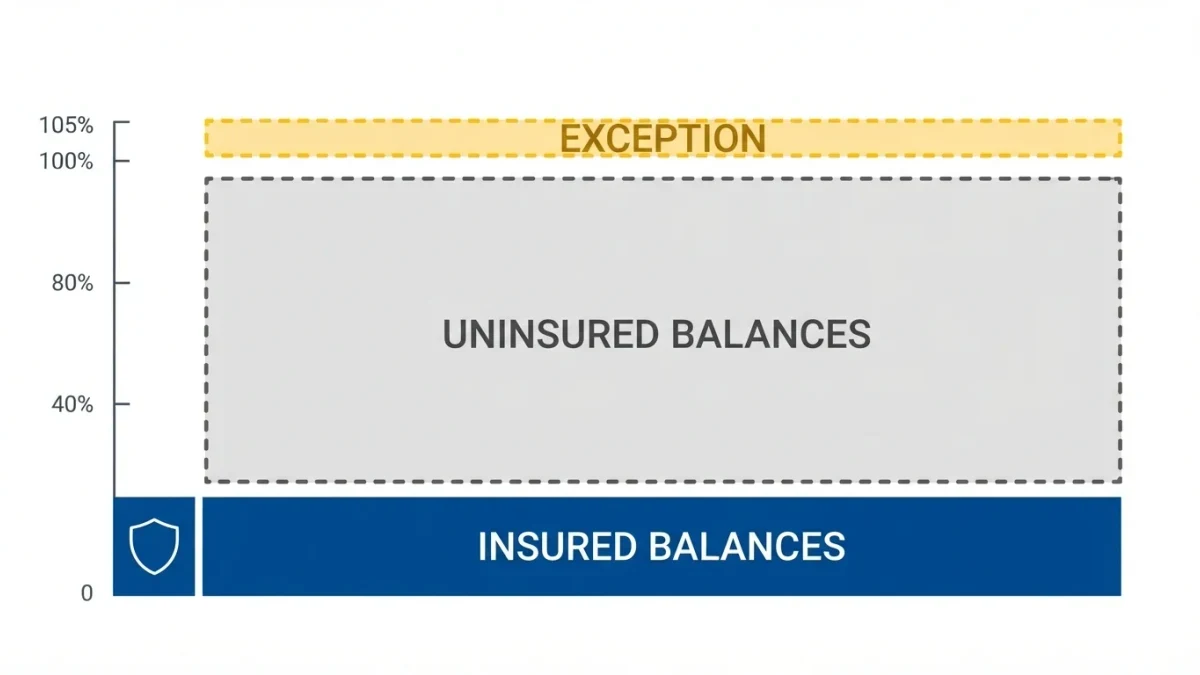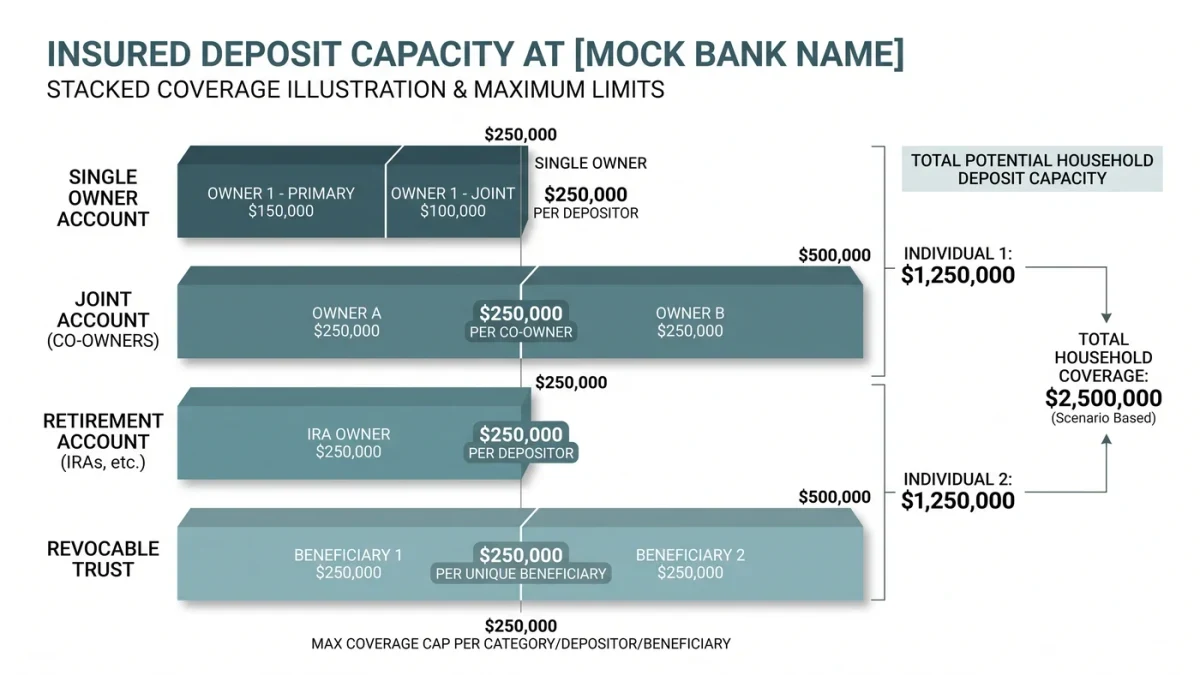
Federal deposit insurance covers $250,000 per depositor, per insured bank, per ownership category — a formula that means a household can hold far more than $250,000 of coverage at a single bank by using different ownership categories: a single account, a joint account, retirement accounts, and revocable trust registrations each receive separate capacity. The Deposit Insurance Fund behind the promise is administered by the Federal Deposit Insurance Corporation, funded by assessments on banks — not taxes — and has covered every insured deposit in full since the FDIC's 1933 creation. The limit was $100,000 from 1980 until the 2008 crisis raised it temporarily, then permanently to $250,000 in 2010.
This explainer covers a federal insurance program.
What is an ownership category?
The FDIC's rules recognize single accounts (one person's sole accounts aggregated together), joint accounts (each co-owner insured up to $250,000 for their share — $500,000 total for a two-owner account), certain retirement accounts including IRAs, revocable trust registrations where coverage depends on the number of beneficiaries, employee benefit plan accounts, business accounts as their own category per entity, and government accounts. The multiplication is legal and intended: a married couple with individual accounts, a joint account, and a revocable trust naming two children can hold well over a million in insured capacity at one bank. The FDIC's Electronic Deposit Insurance Estimator computes exact coverage from the account structure.
What is insured — and what is not?
Insured: checking, savings, money market deposit accounts, certificates of deposit, cashier's checks, and most retirement account deposits at member banks. Not insured: investments in stocks, bonds, mutual funds, or exchange-traded funds sold through a bank, including annuities and securities in brokerage arms — those fall to SIPC and private insurance, which protect against broker failure, not market loss. The confusion is routine at bank branches that sell both, and the distinguishing line is simple: deposit products at an FDIC-member bank are insured; anything that can lose value is not deposit insurance's business.
What happened to coverage in 2023?
The standard limit held; the exceptions expanded it. When Silicon Valley Bank and Signature Bank failed with the majority of deposits uninsured, regulators invoked the systemic-risk exception to protect all depositors at those banks, funded by the Deposit Insurance Fund recovered through special assessments on the industry — not, officials stressed, taxpayer money. The episode renewed the standing policy debate: banks argue the $250,000 limit is operationally outdated for payroll accounts — businesses that must concentrate balances — while raising it shifts more risk to the fund and, critics argue, subsidizes bank risk-taking. No legislative change followed; the limit stands, and the 2023 precedent is a fact about political willingness rather than a rule to rely on.
How should large balances be structured?
The lawful toolkit: multiple ownership categories at one bank as the rules provide; multiple banks, each with its own full coverage, including brokered deposit services that spread large sums across a network of banks in CDs; and, where the goal is safety plus yield, Treasury securities with explicit full-faith-and-credit backing in unlimited amounts through TreasuryDirect. What does not work: account titles alone — coverage follows legal ownership and registration as documented, not nicknames; and moving money on a Friday when a bank wobbles, which is how 2023's digital bank runs unrolled balances in hours.
How do you verify coverage?
Check the bank's FDIC membership (the FDIC's BankFind tool), run the estimator on your exact structure, and keep titling documents consistent with what the tool assumed. The system's promise is narrow, precise, and reliable: $250,000 per depositor, per bank, per category — and everything beyond it is a credit decision you are making.