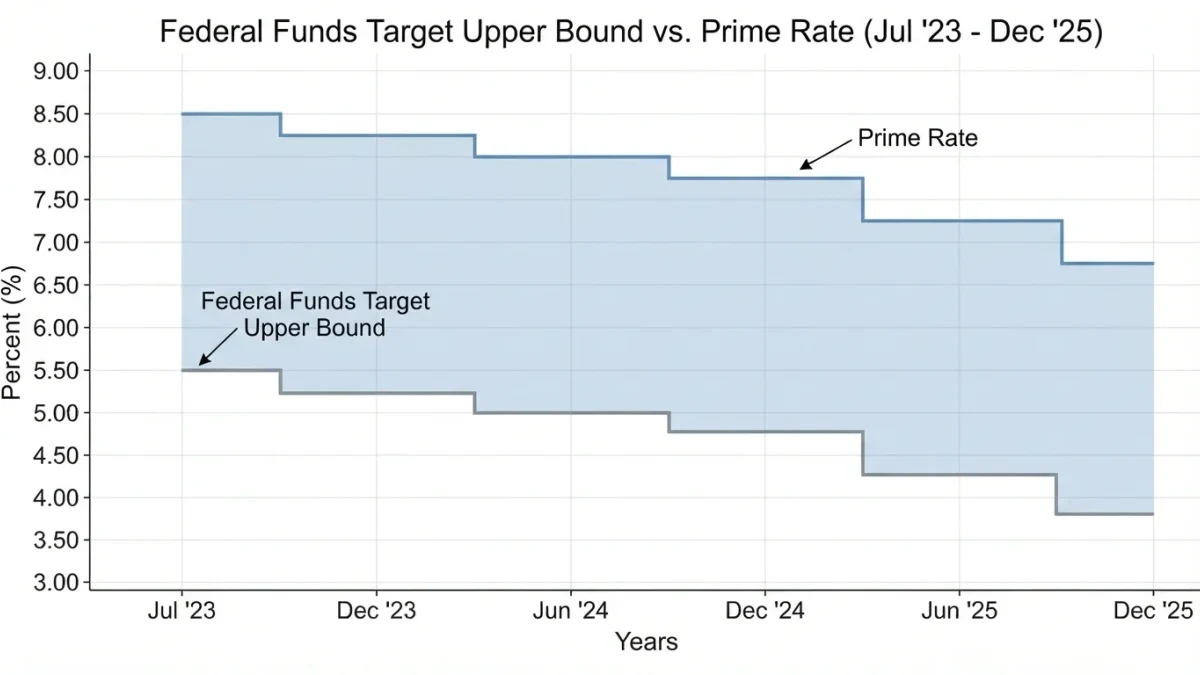
The federal funds rate — the overnight rate at which banks lend reserves to each other, set as a target range by the Federal Open Market Committee — is the anchor for nearly every short-term rate in the economy, but it reaches savers and borrowers unevenly. After the FOMC cut its target range by a full percentage point across its September and October 2025 meetings, taking the range to 3.75–4.00 percent, credit card APRs barely moved while savings rates fell within weeks. Transmission is real, fast at the short end, and deliberately asymmetric.
Rates cited are official levels, not recommendations.
What did the Fed actually change?
The FOMC sets a target range and uses administered rates — interest on reserve balances and the overnight reverse repurchase facility — to keep the effective fed funds rate inside it. Between meetings, the effective rate moves only a few basis points. This plumbing matters to households only through one channel: the whole structure of money-market yields repricing off it, from Treasury bills to savings deposits.
Why do savings rates move fast?
Online banks and money-market funds compete for deposits that can leave with a click, so their yields track the effective rate with a lag of days to weeks. After the 2022–2023 hiking cycle took the range to 5.25–5.50 percent, top online savings yields reached the mid-4s; as the FOMC cut in late 2024 and 2025, those offers repriced down within a month of each decision. Brick-and-mortar branch banks, whose depositors are less rate-sensitive, adjust far more slowly and by less — the pass-through gap between the big banks and online competitors has historically run one to two full percentage points.
Why are credit card rates sticky downward?
Credit card APRs are indexed to the prime rate — typically the effective fed funds rate plus about 3 percentage points — so they reprice upward mechanically and almost immediately. Downward, issuers adjust the fixed margins layered on the benchmark much more cautiously, citing loss rates and funding costs. The result across cycles: card rates rise within one or two billing cycles of hikes but take quarters to reflect cuts. The Consumer Financial Protection Bureau has documented that spread widening repeatedly.
What about loans tied to SOFR and longer rates?
Floating-rate credit — variable private student loans, some auto loans and HELOCs, most business lending — now prices off SOFR, the Secured Overnight Financing Rate that replaced LIBOR as the dollar floating benchmark in 2023. These reset on contract schedules, usually monthly or quarterly. Mortgages are the exception that proves the rule: a 30-year fixed rate tracks the 10-year Treasury yield and mortgage-backed securities pricing, not the overnight rate, so the Fed can cut while mortgage rates hold steady if the market has already priced the cuts in.
How should a household read a Fed decision?
Match each rate you pay or earn to its true benchmark: savings and money funds to the effective fed funds rate, cards to prime, floating loans to SOFR, fixed mortgages to the 10-year Treasury. Then expect the documented asymmetry — deposits and card APRs reprice quickly upward, slowly downward — and treat any Fed statement's guidance about future meetings as expectation, not commitment.