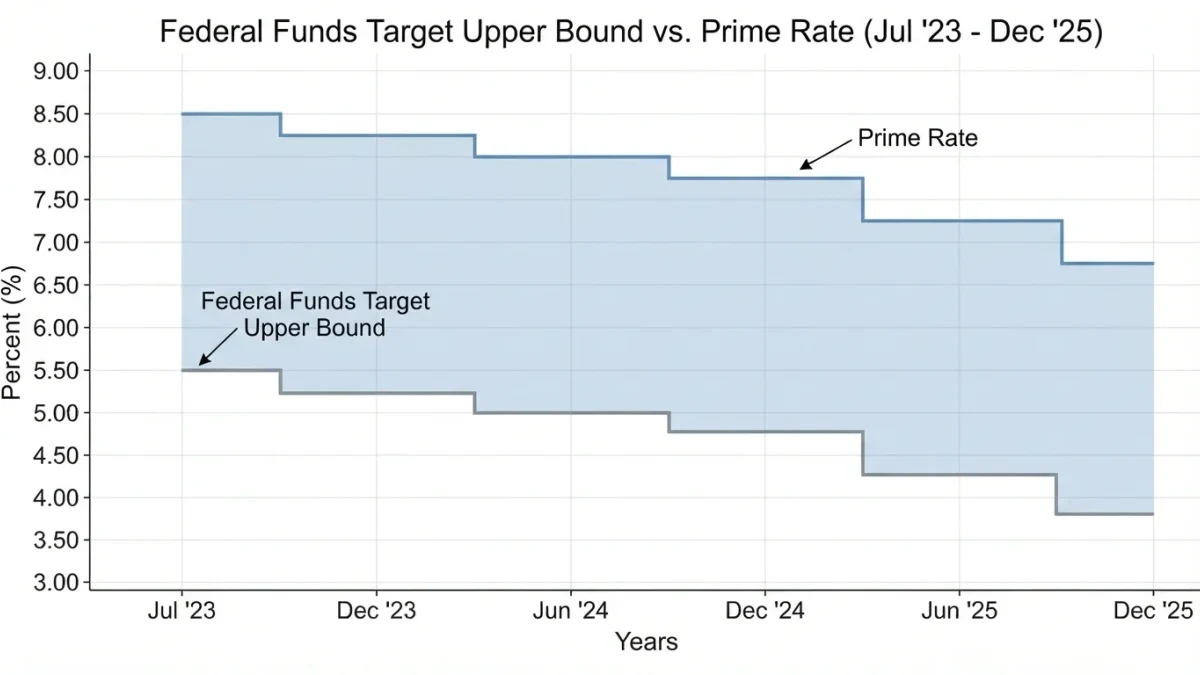
Credit card annual percentage rates are variable, indexed to the prime rate — the benchmark banks quote for their best customers, set at the effective federal funds rate plus roughly 3 percentage points. A card priced at prime plus 12 carries about a 19 percent APR when the prime sits near 7; the 2022–2023 hiking cycle lifted the average card APR above 21 percent, a record, per Federal Reserve data on accounts assessed interest. Margins above prime are set from the applicant's credit profile, so the same Fed decision produces different card costs for different households — often by 10 points or more.
This explainer covers how card pricing works.
What sets the margin over prime?
Issuers price risk: credit score bands, income, existing utilization, and payment history feed underwriting models that assign the spread over the benchmark. The CARD Act of 2009 constrains how rates change — rate increases on existing balances are generally restricted, promotional rates must last at least six months, and penalty APRs have notice requirements — but it does not cap the initial spread. That is why margin compression is rare: competition for prime-scored customers shows up in rewards and sign-up bonuses rather than in APR, because the profitable prime customer revolving occasionally at 20-plus percent funds the whole structure.
Why do card rates fall slower than the Fed cuts?
Mechanically, they don't: the indexed portion reprices within one or two billing cycles of a prime-rate move, in both directions. What crawls is the effective average — because issuers raise margins on new accounts between cycles, because penalty and cash-advance tiers move on their own schedules, and because the mix of accounts shifts. Fed data through the 2024–2025 cutting phase showed average assessed-interest APRs declining by noticeably less than the cumulative fall in the prime. The spread over the policy rate has trended wider for two decades, a fact the Consumer Financial Protection Bureau has documented in successive biennial reports.
What is the grace period escape hatch?
The APR is a charge on revolving balances only. Federal Reserve Board Regulation Z requires that cards carrying a grace period — typically at least 21 days after the statement closes — extend it to balances paid in full, meaning a cardholder who pays the statement balance by the due date pays no interest at all, at any APR. The interest rate matters to the roughly 45 to 50 percent of active accounts the American Bankers Association reports as revolvers; for full payers it is irrelevant except as a signal of how the issuer values them.
How do penalty APRs and cash advances differ?
Cash advances carry separate, higher rates that start accruing immediately with no grace period. Penalty APRs — triggered by 60-day delinquency — can reach 29.99 percent and, under CARD Act rules, must be reviewed and reduced after six months of on-time payments. Balance-transfer offers price at promotional rates that expire to the standard variable formula, which is where the arithmetic of payoff plans usually breaks.
What should a cardholder actually watch?
Three lines on the disclosure: the index (prime), the spread, and the penalty tier. The index is macro and unhedgeable by the household; the spread was set by the credit profile at application and can improve only via reapplication or renegotiation; the penalty tier is behavior. In a falling-rate cycle, the practical lever is transferring or consolidating balances while prime is low — and reading the post-promotional rate before the clock starts.