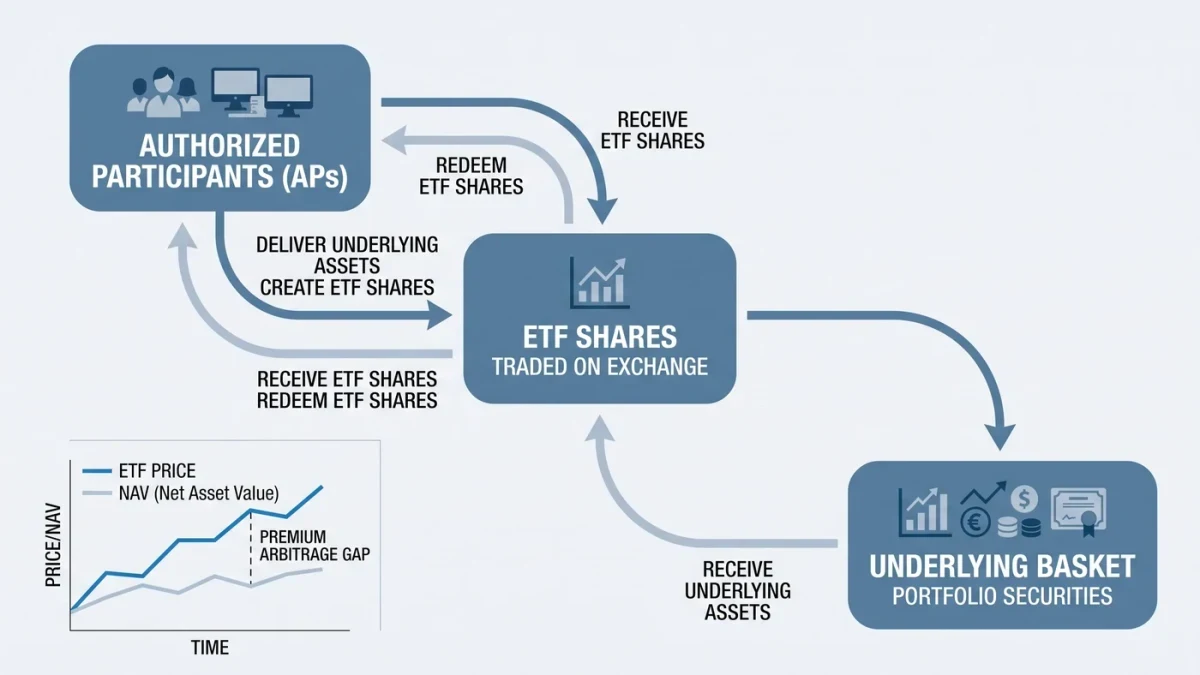
An index mutual fund and an exchange-traded fund tracking the same benchmark hold nearly the same portfolio, but they transact differently: mutual funds price once daily at net asset value with the fund itself as counterparty, while ETFs trade continuously on exchanges between shareholders, with authorized participants creating and redeeming shares in kind against the portfolio. That single structural difference drives everything observable — trading flexibility, cost layers, tax behavior, and the market-structure quirks unique to each. U.S. ETF assets crossed $10 trillion in 2024, per industry data, overtaking mutual funds' long dominance in fund flows.
This explainer covers product structure.
What is the creation-redemption mechanism?
ETF shares exist because institutional authorized participants assemble baskets of the fund's underlying securities and exchange them, in kind, for ETF shares — creation — or reverse the trade — redemption. This arbitrage loop keeps the ETF's market price pinned to its net asset value: when the price drifts above NAV, APs create shares and sell the premium away; below, they redeem. It is also the tax machinery: in-kind redemption lets ETFs expel low-basis shares without selling them, which is why broad ETFs distribute almost no capital gains while mutual funds — which must sell securities to meet redemptions — regularly do.
What does intraday trading actually cost?
A mutual fund transacts exactly at NAV, no spread. An ETF transacts at market, so the buyer pays half the bid-ask spread plus any premium or discount to NAV — real costs layered on top of the expense ratio, invisible in the headline fee comparison. Heavily traded ETFs on liquid indexes carry spreads of a cent or two; niche ETFs on thin markets carry spreads and premiums that can exceed a year's expense ratio in a single trade. The comparison is honest only when trading costs are counted with fees.
What happened in flash-crash episodes?
On stressed days — August 24, 2015, and March 2020 among them — ETF prices detached from stale underlying quotes, printing absurd lows that NAV pricing by definition cannot print. Circuit breakers and market-maker obligations were adjusted afterward, and the episodes' lesson is structural: an intraday instrument inherits intraday fragility. Mutual funds never misprice because they never price until the close — the same property that makes them unusable for anyone who needs to trade at 2 p.m.
How do the fee structures compare?
Expense ratios converge at the cheap end — the largest S&P 500 products in either wrapper run 3 to 10 basis points — so structure, not fee, is the modern differentiator. Mutual funds offer automatic investment and fractional-dollar purchases natively; ETFs offer limit orders, shortability, options, and portability across brokers. Minimums, once a mutual-fund advantage, have largely eroded. Active management, historically mutual-fund territory, migrated into the ETF wrapper through the 2019 SEC rule easing custom portfolio disclosure — the active ETF is now where new launches cluster.
Which fits which use case?
The general mapping practitioners state: systematic recurring purchases are simplest in mutual funds; lump-sum deployment, tax-loss precision, and trading flexibility belong to ETFs; and in taxable accounts the ETF's in-kind tax advantage compounds over decades. The wrapper is plumbing — but plumbing determines what flows smoothly.