Market capitalization — share price times total shares outstanding — is the headline value of a company, but most institutional uses care about free-float market cap: price times only the shares actually available to trade, excluding blocks held by founders, governments, and strategic holders. The gap can be enormous. A large technology firm where founders hold voting control through dual-class stock can show a float under 60 percent of shares outstanding; state-owned enterprises in emerging markets often float under a quarter. Index providers weight by float because that is the capacity investors can actually buy — which is also why headline market-cap rankings and index influence diverge.
This explainer covers a market-structure distinction.
What counts as free float?
Definitions vary by index provider, but the excluded categories are consistent: shares held by officers, directors, and controlling founders beyond control thresholds; government holdings; cross-holdings by other companies; restricted equity not yet vested or registered; and, in some methodologies, any single holder above a 5 or 10 percent block. The remainder — the float — is assumed to turn over freely. S&P Dow Jones Indices, MSCI, and FTSE Russell each publish float definitions in their methodology documents, and they disagree at the margins, which is why the same company carries different effective weights in different benchmarks.
Why does float matter for liquidity?
Trading capacity scales with the tradable slice. A small float means a modest money-management inflow moves the price, and a modest outflow hits it — float-constrained stocks exhibit higher volatility per dollar of flow. This is structurally true of dual-class founder-led firms and of recent IPOs, where insiders are locked up for 180 days: the unlock expands the float abruptly, and the supply event is priced in advance with documented drift patterns around expiration.
How does float interact with index funds?
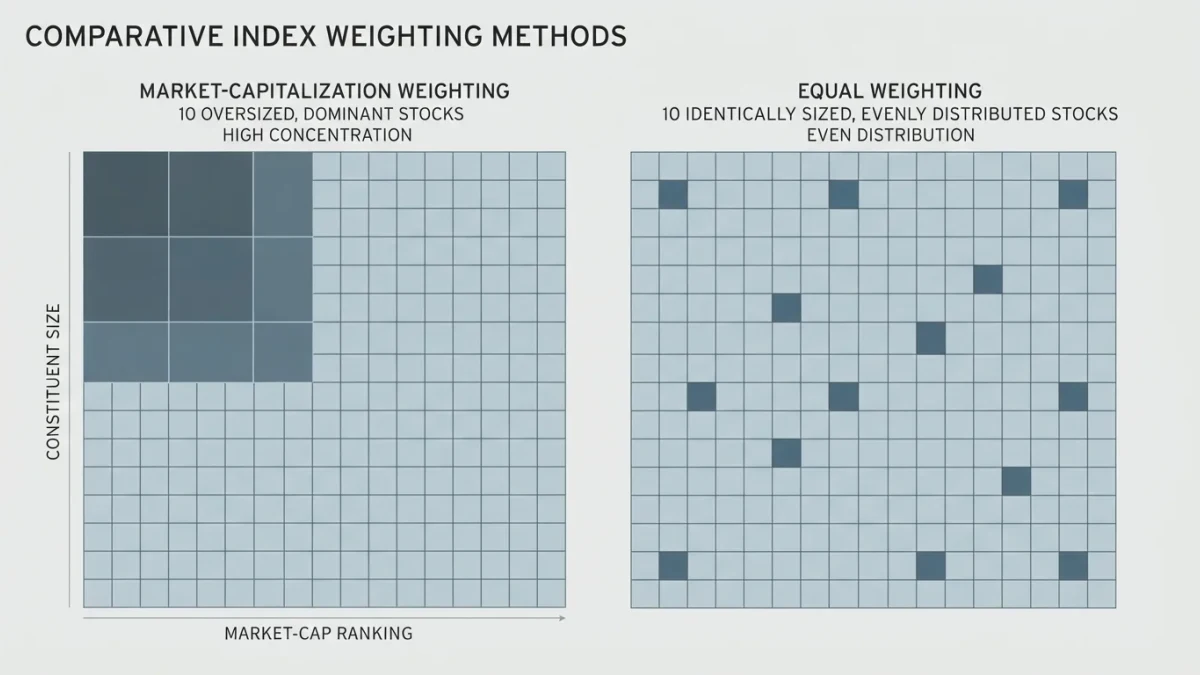
Passive money buys float-proportionally: a stock's weight in a float-weighted benchmark times passive assets in that benchmark is what index funds must hold. When a stock's float shrinks — a buyback retiring float shares, a founder increasing a stake — index demand concentrates on fewer shares. The 2020s buyback wave mechanically boosted the weight of repurchasing companies in float-adjusted benchmarks while reducing the share count available, a feedback analysts cite when explaining concentration dynamics in U.S. indexes.
What is the enterprise-value counterpoint?
Market cap values equity only. Add net debt and you get enterprise value, the whole-company measure used for cross-company comparisons where leverage differs — a retailer and a software firm with equal market caps carry different claims against their cash flows. Equity analysts rank by EV multiples; passive products weight by float-adjusted market cap; headlines quote raw market cap. Three numbers, three purposes, routinely conflated.
Where can readers see float data?
Exchange and index-provider factsheets disclose float-adjusted shares, and SEC filings show insider blocks through Forms 3, 4, and 13D/G. The drill for judging a headline valuation claim: find the insider and strategic holdings, compute what fraction of the headline value is actually purchasable, and treat index weightings, liquidity, and volatility expectations accordingly — headline market cap alone states neither.