The S&P 500 is a market-capitalization-weighted index of about 500 large U.S. companies maintained by the S&P Dow Jones Indices committee, and because trillions of dollars in index funds and benchmarks track it, its construction rules move real money. Weighting is float-adjusted: each company's sway in the index depends on the market value of shares actually available to public investors, not on total shares outstanding. The result is concentration — the ten largest components have recently accounted for roughly a third of the entire index, so its performance is inseparable from a handful of mega-cap technology names.
This explainer covers how the benchmark works.
What qualifies a company for inclusion?
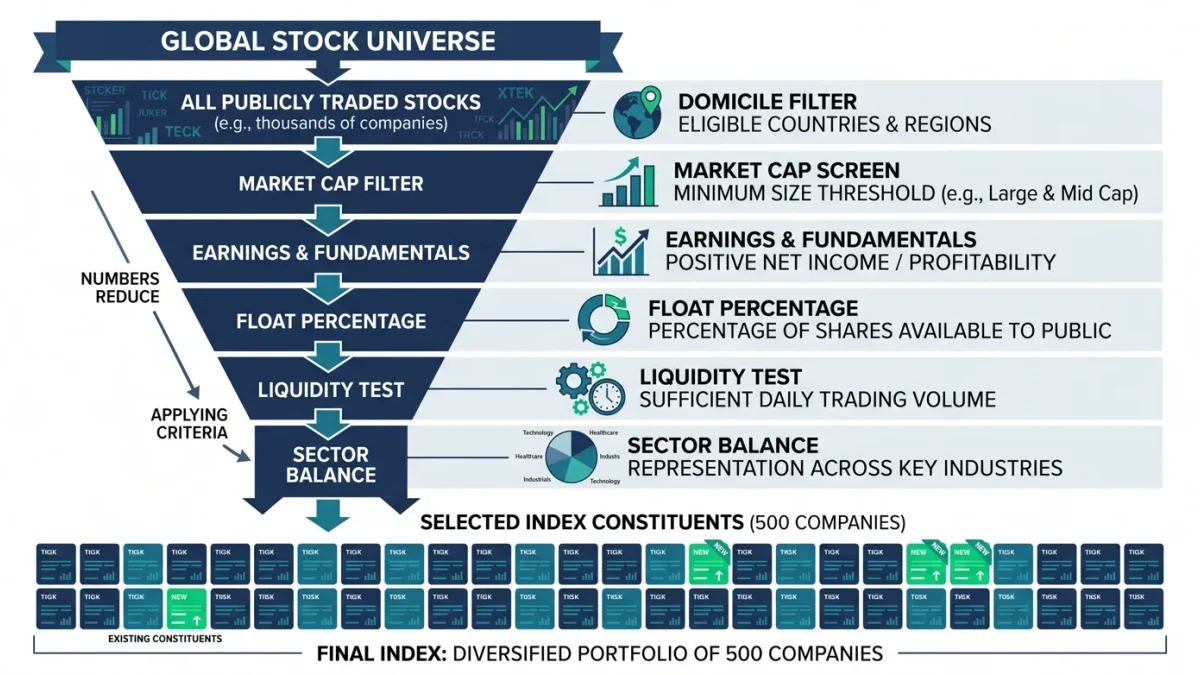
Eligibility criteria require a U.S. domicile, a float-adjusted market capitalization of at least $20.5 billion (a threshold the committee periodically raises), positive trailing four-quarter earnings on a GAAP basis, adequate liquidity and public float, and an investment-grade credit profile in most cases. The last criterion is a guideline rather than law: the committee retains discretion. Because inclusion effectively guarantees index funds will buy the stock, additions and deletions are announced days in advance and produce measurable trading volume at the effective rebalance close.
How does float-adjusted weighting work?
Take the shares available to public investors, multiply by the share price, divide by the sum for all 500 companies, and that fraction is the stock's weight. Founder- and insider-held blocks that never trade are excluded from the calculation. This is why two companies with similar headline market values can carry meaningfully different index weights, and why share buybacks — shrinking the float while lifting the price — interact with index weights in ways equal-weighted benchmarks ignore.
When do stocks enter and leave?
Deletions follow mergers, acquisitions, bankruptcies, or sustained failure to meet criteria; additions fill vacancies, usually drawn from profitable large caps outside the index. Index changes cluster: a large acquisition closing can force a reshuffle of several names at once. Each announcement states the effective date, and arbitrage desks trade the predictable flows — a mechanical feature of modern markets that exists because so much money is contractually bound to replicate this one committee's decisions.
What does the index actually represent?
It is a large-cap U.S. equity benchmark, not "the market": it excludes small caps (the domain of the Russell 2000), most mid caps, and any company lacking positive earnings. Sector weights drift with prices — technology and communication services grew to over 40 percent of the index by the mid-2020s, versus about a fifth two decades earlier. The S&P 500's total-return version adds reinvested dividends; the headline number quoted in news reports is the price index and understates long-run returns by the dividend yield, roughly 1.3 percent annually in recent years.
How does the committee rebalance?
Share counts and floats update quarterly, in March, June, September, and December, when the divisor is adjusted so membership changes do not distort the index level. Between rebalances, weights move with prices daily. The full methodology, including the earnings criteria and the float definitions, is published by S&P Dow Jones Indices.
For a benchmark that decides the holdings of most retirement portfolios by default, the striking fact is how much hinges on committee judgment — eligibility screens select the candidates, but a small committee of index analysts makes the call that triggers billions in fund flows.