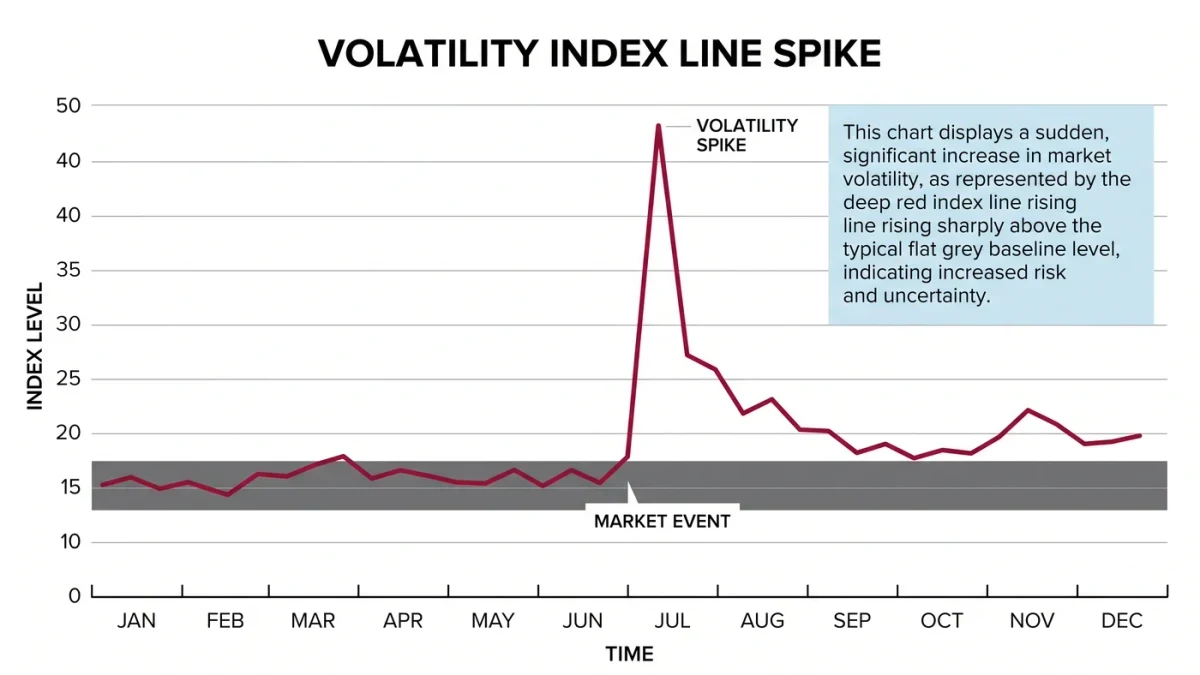
The VIX — the Cboe Volatility Index — measures the market's expectation of S&P 500 volatility over the coming 30 days, calculated from the prices of out-of-the-money options on the index and quoted in annualized percentage points. A VIX of 15 means options prices imply swings consistent with about 15 percent annualized movement; a reading above 30 means insurance against index moves has gotten expensive fast. Its long-run median sits in the high teens, and spikes above 40 have come almost exclusively in genuine crises — 2008, March 2020, and the August 5, 2024, yen-carry-trade unwind that briefly lifted it above 60 intraday.
This is an explainer of a widely quoted indicator, not a market call.
How is the VIX calculated?
Cboe takes a weighted strip of S&P 500 put and call options expiring in roughly 23 to 37 days, extracts the implied volatility each price implies, and interpolates a single 30-day figure. Because the calculation uses options at many strikes, it effectively prices the whole distribution of outcomes, not just one forecast. The index rises when demand for protection rises relative to supply — which can reflect selling pressure, event risk like elections or Fed meetings, or forced hedging, not necessarily fear itself.
Why is calling it a fear gauge misleading?
Fear is one input among several. The VIX also rises before scheduled events — FOMC meetings, inflation releases, elections — when hedging demand is mechanical rather than emotional. It can stay low while single stocks are turbulent, because it references only the S&P 500. And it is a price: when hedging supply is plentiful, as in the low-volatility years of the mid-2010s and much of 2023–2024, substantial risk coexisted with sub-15 readings. The nickname sells the mechanism short.
What do level bands mean in practice?
Bands are conventions, not rules: below 13 has marked unusually quiet markets; the teens are normal; the mid-20s accompany genuine stress; and readings above 30 have historically coincided with annualized realized vol well above that. Two features of the series matter more than levels. Mean reversion: over long horizons the VIX has tended to fall back toward its average, which is why trading volatility itself is a professional's game. Asymmetry: the index jumps faster on the way up than it grinds on the way down, because protection demand spikes in selloffs and decays slowly in recoveries.
How is the VIX traded?
The index itself is not buyable. Futures on it trade on Cboe with a term structure that usually slopes upward — the further-out contracts cost more, a condition called contango that erodes the returns of products that roll futures. Exchange-traded products tied to VIX futures exist, and their long-run performance shows the cost of that roll: holding volatility insurance continuously has historically lost money, because insurance usually expires unused. Short-term inverse products behave with mirrored violence on spike days.
Where did the index come from?
Cboe introduced the index in 1993 using at-the-money options and adopted the current interstrike methodology, based on work by Menachem Brenner and Dan Galai and a formula refined by Robert Whaley, in 2003. Real-time calculation and the futures market followed. The result is the market's single most-quoted number after price levels themselves — an insurance premium with a ticker.